Pool Cage Rescreening in Jacksonville, FL
Florida’s sunshine, humidity, seasonal storms, and everyday outdoor exposure can gradually wear down the screening on a residential pool enclosure. Over time, screen mesh may become brittle, develop tears, loosen around the edges, or begin to sag. When damage affects multiple areas of a pool cage, replacing individual panels one at a time may no longer be the most practical solution.
Schnorr Home Improvements provides pool cage rescreening services in Jacksonville, FL, and surrounding Northeast Florida communities. Since 1979, our company has helped homeowners improve their outdoor living spaces through screen enclosures, pool enclosures, sunrooms, and related home improvements.
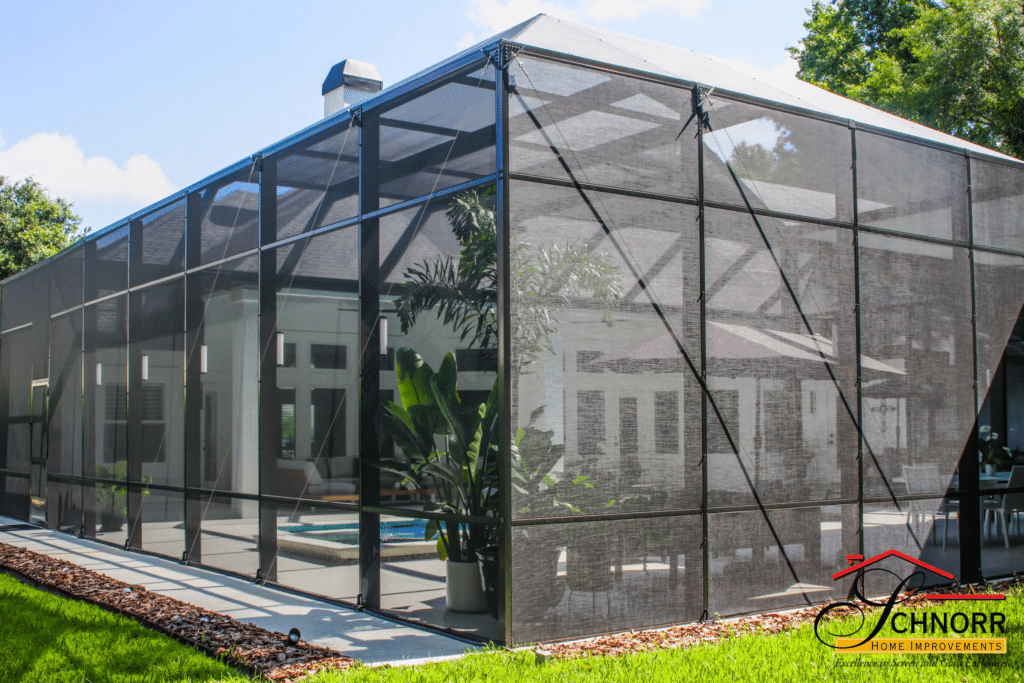
Pool cage rescreening involves replacing deteriorated screen mesh across larger sections or throughout an existing enclosure while retaining the aluminum framework when its condition allows. The goal is to restore the screened barrier around the swimming pool, improve the appearance of the enclosure, and help reduce the entry of insects, leaves, and other outdoor debris.
If you are considering pool cage rescreening, Request a Consultation or Call Schnorr Home Improvements at (904) 262-1517 to discuss your existing enclosure.
Whether your pool cage has numerous torn panels, aging roof screens, or screening that has deteriorated after years of exposure, evaluating the condition of the entire enclosure can help determine whether selective replacement or more extensive rescreening is appropriate.
When Does a Pool Cage Need Rescreening?
Pool cages are exposed to changing weather conditions throughout the year. Sunlight, moisture, wind, landscaping, and routine wear can affect the condition of the screening even when the aluminum framework remains serviceable.
One damaged panel does not necessarily mean an entire pool cage needs rescreening. However, when the screening begins to fail in multiple locations, broader replacement may provide a more consistent and practical result.
Common Signs of Deteriorating Pool Cage Screens
Several conditions may indicate that your enclosure is ready for a rescreening evaluation:
- Multiple torn or punctured panels: Damage appears throughout the roof, walls, or several sections of the enclosure.
- Brittle or weakened mesh: Older screening tears easily or shows signs of deterioration from prolonged outdoor exposure.
- Sagging or loose screens: Panels no longer maintain their intended tension or appearance.
- Screen separation: Mesh pulls away from the frame channels or retaining spline.
- Repeated screen repairs: New tears continue developing in other aging panels after individual replacements.
- Increased insect or debris entry: Gaps and damaged screening reduce the effectiveness of the enclosure.
These conditions do not automatically require complete rescreening. The extent of the damage, age and condition of the remaining mesh, and condition of the supporting frame should all be considered before determining the appropriate scope of work.
Pool Cage Roof and Wall Rescreening
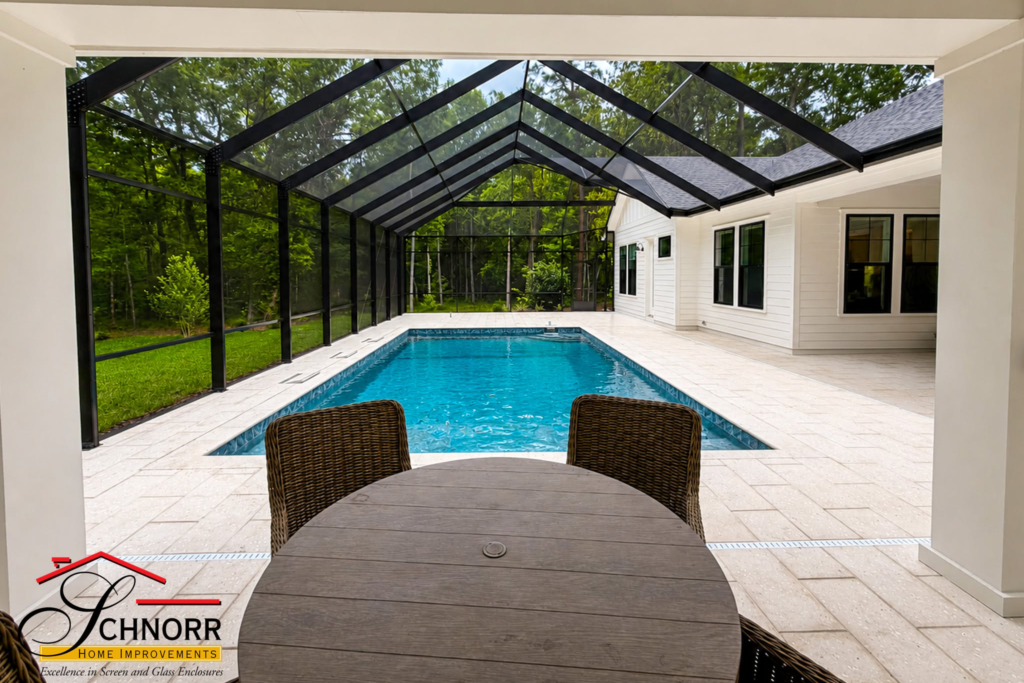
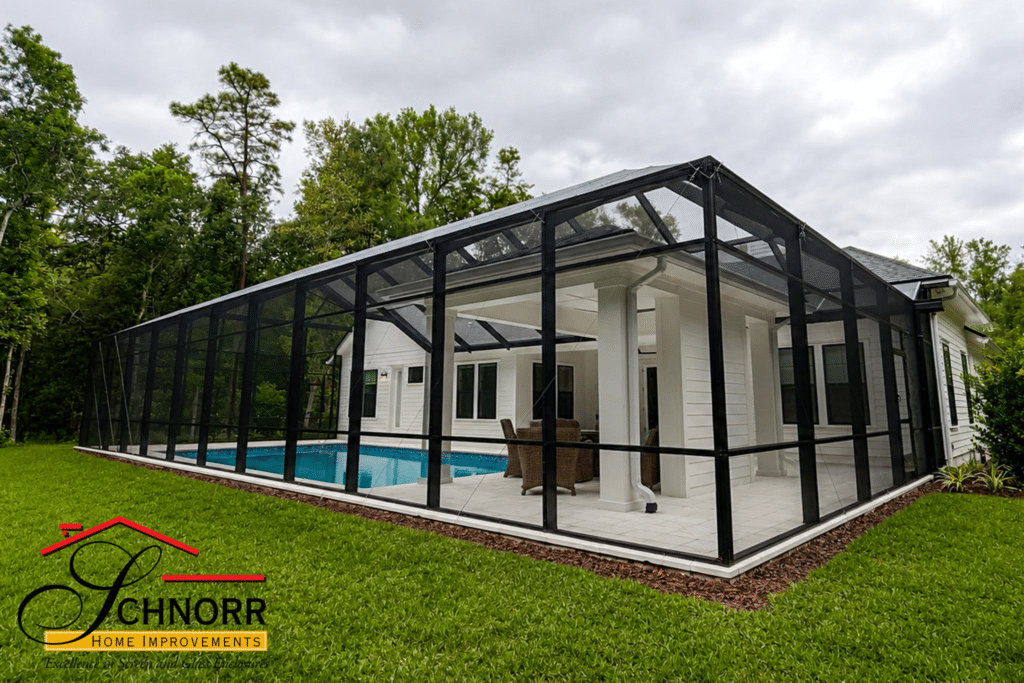
A residential pool cage typically includes vertical screened walls and overhead screen panels supported by an aluminum framework. Depending on the enclosure’s design, the roof may contain flat, sloped, gable, dome-shaped, or other screen configurations.
Each section presents different considerations for access, screen dimensions, material selection, and installation.
Replacing Pool Cage Roof Screens
Roof screening is an important part of the enclosure because it helps reduce the amount of leaves, insects, and other debris entering the pool area from above.
Overhead panels can be especially difficult for homeowners to inspect closely. Small openings, loose mesh, or weakened screening may be less noticeable until debris begins entering the enclosure or the damage becomes more extensive.
Roof rescreening requires consideration of the enclosure’s height, roof configuration, panel dimensions, accessibility, and existing frame condition. Elevated or difficult-to-reach panels may require specialized access arrangements and additional safety precautions.
Before roof screens are replaced, the enclosure should be evaluated to determine whether the supporting framework and screen-retaining channels are suitable for the proposed work.
Rescreening Pool Cage Walls and Vertical Panels
Vertical pool cage screens form the screened perimeter around the swimming pool, deck, and surrounding outdoor living area.
These panels may experience damage from landscaping, pets, outdoor furniture, routine activity, or long-term weather exposure.
When numerous wall panels have deteriorated, replacing the screening across a larger section can improve the enclosure’s overall appearance and reduce inconsistencies between old and new mesh.
Wall rescreening also requires attention to door openings, panel dimensions, screen tension, and the condition of the existing aluminum channels.
The objective is to restore functional screening while preserving the existing enclosure structure where appropriate.
Choosing the Right Screen Mesh for Your Pool Cage
Not all screen mesh is designed for the same application. Different screening products can vary in visibility, airflow, insect protection, durability, and resistance to everyday wear.
Standard fiberglass insect screening is commonly used in residential enclosures because it provides ventilation and insect protection while maintaining outdoor visibility. Other mesh options may offer different characteristics, including finer openings, increased resistance to certain types of damage, or improved visibility.
When comparing screening materials, homeowners should consider how the enclosure is used and which features matter most.
A finer mesh may help limit the entry of smaller insects, but it can also affect airflow and visibility. Heavier or more durable screening may be appropriate for certain applications, although compatibility with the existing enclosure and its screen-retaining system must be evaluated.
Mesh color, openness, panel dimensions, manufacturer specifications, and installation requirements can also influence the finished appearance and performance.
No screen mesh should be assumed to make an existing pool cage hurricane-proof or structurally stronger. Material selection should account for the enclosure’s design and applicable requirements rather than relying on generalized wind-resistance claims.
During a consultation, homeowners can discuss which compatible screening options may be appropriate for their existing pool cage.
What Is Involved in Pool Cage Rescreening?
The scope of a pool cage rescreening project depends on the enclosure’s size, configuration, accessibility, screening condition, and existing framework.
Although individual projects vary, understanding the general rescreening process can help homeowners prepare for an evaluation.
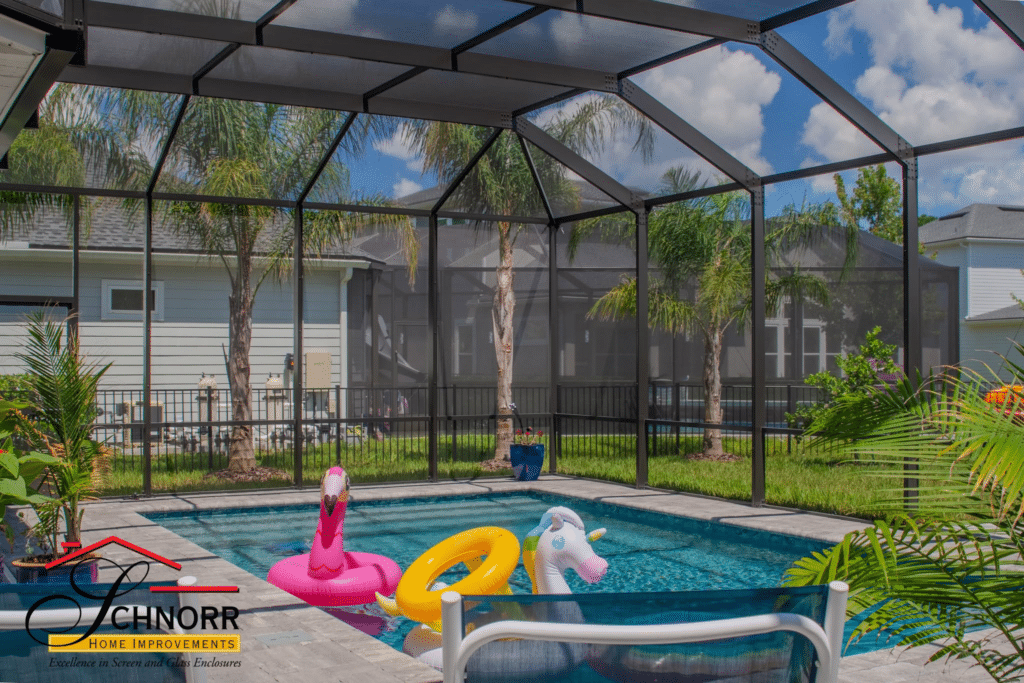
Evaluating the Existing Enclosure
A rescreening assessment begins with determining which areas need replacement and whether the existing enclosure can accommodate the proposed work.
Important considerations include the condition of the roof and wall screening, the number of deteriorated panels, accessibility, and the suitability of the existing aluminum framework.
Screen-retaining channels, spline, doors, and other relevant components may also need to be examined. Problems with the frame or attachment system can affect whether new screening can be installed properly.
This evaluation helps distinguish between an enclosure that primarily needs new mesh and one that may require separate structural attention.
Removing and Replacing Screen Mesh
In a typical rescreening project, deteriorated mesh is removed from the selected openings. New screening is then fitted and secured using a compatible retaining system, commonly involving spline installed within the frame channels.
The condition and compatibility of the existing spline and channels are important. Retaining components may need replacement when they are worn, damaged, or unsuitable for the selected mesh.
Screen tension must be appropriate for the material, panel dimensions, and enclosure design. Proper installation helps limit loose edges, uneven screening, and premature problems.
Work involving overhead panels or difficult-to-access sections also requires consideration of safe access and protection of the surrounding pool deck, landscaping, and outdoor furnishings.
The exact preparation, installation approach, and project requirements depend on the condition and configuration of the individual enclosure.
Pool Cage Rescreening vs. Individual Screen Panel Repair
Homeowners often ask whether they should replace a few damaged panels or rescreen the entire pool cage.
The answer depends on the condition of the remaining screening.
Individual panel repair may be appropriate when damage is limited to one or several panels and the surrounding mesh remains in good condition. Replacing only the affected panels can restore the screened barrier without disturbing other serviceable areas.
For homeowners with isolated tears or openings, our Pool Enclosure Screen Repair service provides more information about localized screen replacement.
Broader or complete rescreening may be preferable when many panels are brittle, sagging, torn, or nearing the end of their useful service life.
Replacing a larger portion of the screening can reduce the need to repeatedly address failures in adjacent aging panels. It may also provide a more uniform appearance, particularly when the existing screens have faded or deteriorated unevenly.
A complete rescreening is not always necessary. Some enclosures may benefit from replacing an entire roof section, one or more wall sections, or another defined portion of the existing screening.
For an overview of related services, visit our Screen Repair page.
Pool Cage Framing, Accessibility, and Structural Considerations
Rescreening replaces the mesh installed within an existing pool cage. It does not automatically repair or replace the aluminum framework supporting the enclosure.
Before proceeding, homeowners should understand whether the existing structure is suitable for continued use.
Bent or damaged aluminum members, loose connections, corroded components, damaged anchors, and other structural concerns may require additional evaluation.
The condition of the frame channels also matters because these channels help retain the screening. Damaged or unsuitable channels can interfere with proper screen installation.
Accessibility is another important consideration. Tall enclosures, elevated roof panels, nearby landscaping, narrow access areas, and the arrangement of the pool deck can affect how work is approached.
Replacing screen mesh does not restore damaged structural members, correct deficient anchoring, or guarantee resistance to hurricanes or severe wind events.
If substantial structural damage is present, separate repairs, professional evaluation, or replacement of the enclosure may need to be considered before rescreening.
Homeowners evaluating a completely new structure can learn more about Schnorr’s Pool Enclosures services.
Why Choose Schnorr Home Improvements?
Schnorr Home Improvements has served Jacksonville and Northeast Florida homeowners since 1979, providing residential improvements that include sunrooms, screen enclosures, pool enclosures, and other outdoor living structures.
Our longstanding involvement with screened structures gives homeowners an established local company to contact when evaluating their existing pool cage.
Pool cage rescreening decisions should account for more than the number of damaged panels. The condition of the surrounding screening, aluminum framework, roof configuration, access points, and intended use of the enclosure all affect the appropriate project scope.
Whether you are considering selective mesh replacement or rescreening a larger portion of your enclosure, our team can discuss your concerns and the condition of your existing pool cage.
Homeowners can also explore our Pool Enclosures and Screen Roofs Project Gallery to view examples of screened structures and roof configurations associated with our work.
Pool Cage Rescreening in Jacksonville and Northeast Florida
Schnorr Home Improvements serves homeowners throughout Jacksonville and surrounding Northeast Florida communities.
Our service area includes Jacksonville Beach, Atlantic Beach, Neptune Beach, Ponte Vedra Beach, Nocatee, St. Johns, Mandarin, Julington Creek, Fruit Cove, Orange Park, Fleming Island, St. Augustine, Amelia Island, and Fernandina Beach.
The region’s warm climate, humidity, frequent rain, and seasonal storms can contribute to screening deterioration over time.
Whether your home is near the coast or farther inland, the condition of the existing pool cage should guide the decision between replacing individual panels and pursuing more extensive rescreening.
Contact Schnorr Home Improvements to discuss your location and pool enclosure needs.
Explore Screen Enclosures and Project Photos
Repairing an existing screened space is different from planning a new enclosure. If you are considering a larger change to your outdoor living area, explore our screen enclosures, pool enclosures, and lanai screen enclosures.
You can also browse our pool enclosure and screen roof gallery and screen walls in existing lanais to see examples of screened outdoor spaces.
Frequently Asked Questions About Pool Cage Rescreening
How do I know if my pool cage needs complete rescreening instead of individual repairs?
Complete rescreening may be worth considering when multiple panels are torn, brittle, sagging, or repeatedly failing. If the existing mesh has deteriorated throughout the enclosure, replacing individual panels may address only the most visible damage while leaving other weakened sections in place.
However, an enclosure with a few isolated tears and otherwise serviceable screening may need only localized panel replacement. The most appropriate option depends on the condition of the remaining mesh, the number of affected panels, and the suitability of the existing framework.
Can pool cage roof screens and wall screens be replaced during the same project?
Yes, roof and wall screening can be included within the same rescreening project when the enclosure’s condition, access requirements, and project scope allow.
Roof panels may present additional challenges because of their height, dimensions, and configuration. Wall panels are generally more accessible, although their size and surrounding features also affect the work.
An assessment can help determine whether both areas should be addressed together or whether selective replacement is more appropriate.
Do I have to replace every screen panel if some are still in good condition?
Not necessarily. Partial rescreening may be appropriate when some sections have deteriorated while others remain functional.
For example, a homeowner may need extensive roof screen replacement while the wall panels are still serviceable. Another enclosure may have aging wall screens but relatively newer overhead screening.
The decision should consider the condition of the remaining panels, compatibility and appearance of the replacement mesh, and the likelihood of additional repairs being needed in the near future.
What type of screen mesh is best for rescreening a pool cage in Florida?
The most appropriate mesh depends on the enclosure’s design, the homeowner’s priorities, and the materials compatible with the existing screening system.
Standard fiberglass insect screening is common in residential applications. Other products may offer different levels of visibility, airflow, insect protection, or resistance to wear.
Finer mesh can provide additional protection against smaller insects but may reduce airflow. More robust screening may offer benefits in certain applications, but it should not be selected without considering panel dimensions and manufacturer requirements.
A consultation can help identify suitable options for the existing enclosure.
Does pool cage rescreening include repairs to damaged aluminum framing?
Rescreening primarily involves replacing screen mesh, not rebuilding the aluminum structure.
If an enclosure has bent framing, loose connections, damaged anchors, corrosion, or other structural concerns, those conditions should be evaluated separately.
New mesh cannot correct a damaged frame or make an unsafe structure sound. The condition of the existing framework may affect whether rescreening can proceed and whether separate repairs or enclosure replacement should be considered.
Can a pool cage be rescreened after storm damage?
A pool cage may be suitable for rescreening after storm-related damage if the supporting structure remains in acceptable condition.
Storms can damage individual screen panels, larger screened sections, and structural components. For that reason, visible mesh damage should not be the only consideration.
If the aluminum framing, anchors, or connections have been affected, further evaluation may be needed before replacing the screening.
Rescreening can restore damaged mesh, but it does not guarantee that an enclosure will withstand future storms or correct underlying structural deficiencies.
What should I know before requesting a pool cage rescreening consultation?
Before contacting a contractor, consider how many screen panels are damaged, whether the roof screens are affected, and whether you have noticed loose mesh, sagging panels, or visible framing problems.
It can also help to know whether the screening has been replaced previously and whether you are interested in partial or complete rescreening.
Photographs showing the overall enclosure and the areas of concern may be useful when discussing the project.
During the consultation, ask about the condition of the existing structure, the proposed replacement scope, compatible screen materials, access considerations, and any additional work that may be necessary.
Request a Pool Cage Rescreening Consultation
If your pool cage has aging, torn, loose, or deteriorating screens, Schnorr Home Improvements can help you discuss the condition of your existing enclosure and the available options for replacing damaged screening.
Serving Jacksonville and Northeast Florida since 1979, our company understands the importance of maintaining functional, attractive outdoor living spaces.
Whether you are considering replacement of several deteriorated sections or more extensive pool cage rescreening, contact us to discuss your project.
Call Schnorr Home Improvements at (904) 262-1517
At Schnorr Home Improvement, we’ve built our reputation on quality workmanship, the use of the finest materials available, and superior customer service, thereby assuring our customers the best sunrooms available. If your looking for a screen repair service you have come to right place.
At Schnorr, we’ve built our reputation on quality workmanship, the use of the finest materials available, and superior customer service, thereby assuring our customers the best structure available in the marketplace. Your solution for Sunrooms Jacksonville FL.
Screen Repair Design & Construction
Schnorr Home Improvements will custom design and build your sunroom to fit your individual needs and lifestyle. We believe that each successful project depends on a partnership between ourselves and the customer. We’ll work together to match the new Sunroom to the look and style of your home.
Screen Repair Service Customer Satisfaction
Our employees have an average of 25 years of service with Schnorr Home Improvements, thus guaranteeing the most experience people in the business working on your new Sunroom. Our goal at Schnorr Home Improvements is complete customer satisfaction. The majority of our business comes from referrals and we have received hundreds of letters from satisfied customers as proof of our dedication and commitment to this goal.
Screen Repair Service Guarantee
We offer you the best and most reliable warranty in the area. Most of our products come with a five, ten or twenty year warranty direct from the manufacturer, in addition to our 1 year warranty on workmanship. Ask your salesman for more details.
We focus on custom-designing and building screen and glassed in living space of any size, any shape, and any height, to look like an integral part of your home. Please call us at 904-262-1517 or fill in the form on this page to get started.
Considering installation of a new Sunroom, Screen Enclosure, Patio Enclosure, Lanai Enclosure, Pool Enclosure, Florida Room, Patio Cover, Pergola, Screen Lanai Conversion, Glass Lanai Conversion, Outdoor Kitchen, Carport, Vinyl or Glass Windows, Lanai Screen, Replacement Windows, Awnings, Window or Door Awning, Commercial Canopy or Screen Repair you have come to the right place.
Here are Job Showcase Gallery Links
Screen Walls In Existing Lanai
Pool Enclosures & Screen Roofs
Take the time to browse our Job Showcase Gallery by clicking on the links above. Fill the form on this page to contact us or simply call (904) 262-1517.
See for yourself. Come visit our showroom or call us for a free estimate and discuss creative ideas about your next home addition.
For over 45 Years Schnorr Home Improvements Sunrooms has been the standard in beauty, durability, and, above all, dependability.
We service what we sell!
Call (904) 262-1517 or Fill In Form
Customer Testimonials
Screen Repair Services Areas Served
For Sunrooms we service all of Jacksonville, FL and surrounding areas including Jacksonville Beach, Neptune Beach, Atlantic Beach, Ponte Vedra Beach, St Augustine, St Augustine Beach, Nocatee, Ponte Vedra, Palencia, Palm Valley, Fruit Cove, Mandarin, Orange Park, Amelia Island, Fernandina Beach and surrounding areas.